
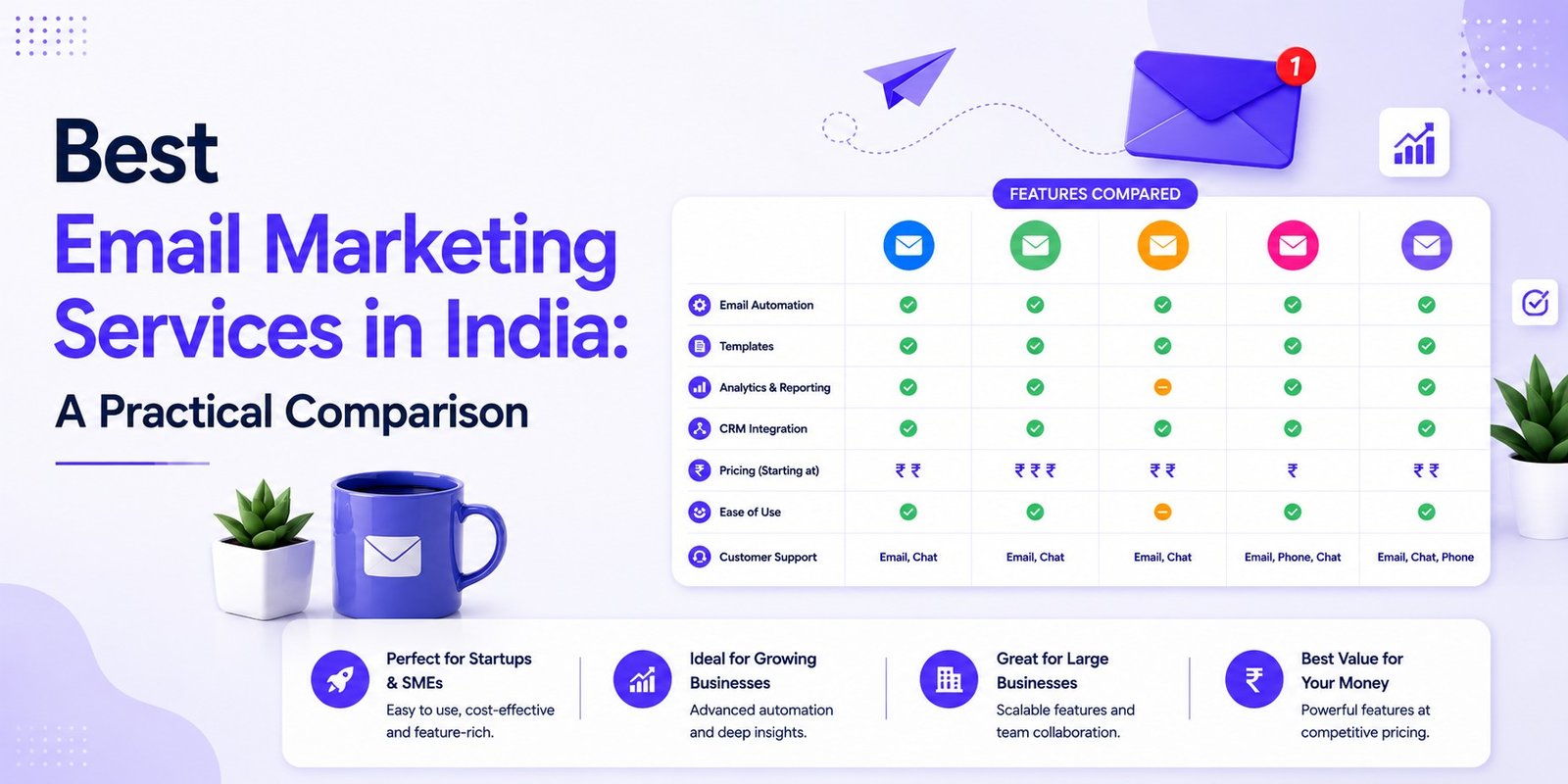
To engage audiences, nurture leads, and maintain consistent communication, Email Marketing remains as effective way for businesses in India. With the right tools and partners, companies can build good relationships with their customers. From comprehensive agency solutions to versatile software platforms, some of the best email marketing services in India are listed below :
1. Technogaze – Email Marketing Services by a Digital Marketing Agency
Where it comes to agency-based email marketing, Technogaze comes as a specialized agency that provides professional expertise at minimal prices. Unlike standalone software, they operate as a full-service digital marketing agency, offering comprehensive email marketing services that cover everything from strategic campaign planning and precise audience segmentation to creative content production and advanced automation setup.
Why does this matter? The benefits of this agency-based approach are significant. Technogaze ensures that your campaigns aren't just sent—they are strategically aligned with your broader business goals to drive higher engagement. They make high-level marketing accessible to businesses of all sizes by offering these expert services at minimal prices and this allows you to reduce operational effort and access scalable, practical results without the heavy financial burden of hiring an in-house team as they already have professional management that is both effective and affordable.
2. Mailjet – Email Marketing Platform for Internal Campaigns
Mailjet is a great choice if your marketing team needs to collaborate on emails the same way they do on a shared document. With a focus on teamwork, it allows businesses to design campaigns, schedule emails, and track performance and its real time collaboration features help teams work efficiently on drafts without the back-and-forth email chains.
While it is flexible, remember that the strategy, content creation, and optimization are still on your to-do list. It works best for teams with some marketing experience who are looking for reliable email marketing platforms to manage their internal communications. Plus, it provides essential reporting on open rates, giving you the insights needed to refine your approach over time.
3. Benchmark Email – Simple Email Marketing Service
As the name implies, Benchmark Email is all about keeping it simple. It gives you a straightforward interface to create, schedule, and send out your campaigns, backed by the basics for tracking how they perform. Just keep in mind that the heavy lifting—like planning your strategy, sorting your lists, and writing the content—is still up to you.
Those businesses which are small and beginners seeking a straightforward service that can be implemented quickly can choose Benchmark as their ideal software for email marketing. Its drag-and-drop editor makes design a breeze, and pre-built templates help you launch campaigns faster, though the ultimate success of those campaigns relies entirely on your own skill.
4. CleverReach – Email Marketing Automation Tools
For those who love to dig into data and workflows, CleverReach focuses heavily on email marketing automation tools and subscriber management. It allows you to build automated workflows and segment contacts deeply, with analytics to back it up.
While it is incredibly useful for recurring campaigns, it doesn’t come with strategic advice. CleverReach is best suited for teams that are already comfortable setting up complex automation triggers. It offers workflow templates to save time, but the logic and strategy behind those workflows need to be defined by you.
5. Mailchimp – Feature-Rich Email Marketing Platform
You likely already know the name. Mailchimp offers a vast array of templates, automation, and analytics for tracking campaign performance. It is easily one of the most versatile email marketing platforms available. While popular, remember that the strategy, content, and daily optimization are handled internally by your team.
This is a great fit for companies that already have a marketing team handling campaigns across different channels. It plays nice with other tools, so connecting your emails to your social media or CRM is straightforward—just keep in mind that you’ll need the internal staff to actually manage that entire ecosystem.
6. AWeber – Reliable Email Marketing and Automation
AWeber is the "old reliable" of the industry. It provides solid tools for newsletters, subscriber management, and basic email marketing and automation. The templates and drag-and-drop editor simplify the creation process, while reporting tools let you keep an eye on performance.
Just like the others, content and strategy remain internal tasks. It is suitable for small businesses or individual creators managing their own campaigns. The built-in analytics help you track subscriber engagement to improve future campaigns, but interpreting that data is up to you.
7. Zoho Campaigns – Integrated Email Platform
If your business is already running on Zoho, this choice is the logical next step. It plugs right into the rest of the suite, giving you the essentials for design, automation, and segmentation without the usual integration headaches. You get the reporting tools to see what’s working, but just remember that the actual strategy is something you’ll need to figure out yourself.
It is best for businesses comfortable managing campaigns internally, especially those already using Zoho CRMs. Its automation rules make it easier to maintain regular communication without manual effort.
8. SmartrMail – Automation-Focused Tool
SmartrMail is niche-focused, emphasizing automated workflows specifically for ecommerce, like those handy abandoned cart follow-ups. Reporting helps optimize campaigns, but flexibility is limited if you want to create custom strategies outside of retail.
It is ideal for businesses with defined automation needs. Trigger-based campaigns ensure timely and relevant messaging, utilizing specific email marketing automation tools to improve customer engagement. However, the creative content—the words that actually sell—must be supplied by your business.
9. GetResponse – Comprehensive Email Marketing and Automation Tools
GetResponse positions itself as an all-in-one solution, offering a combination of email marketing tools, list management, and analytics. Workflow automation saves time, but the content, strategy, and optimization are still handled by users.
It is suitable for businesses wanting internal control while leveraging email marketing and automation. Templates and autoresponders help streamline common campaigns efficiently, making it a robust tool for those with the time to manage it.
10. SendPulse – Multi-Channel Email Marketing Platform
What makes SendPulse interesting is that it goes beyond just email. It brings SMS and web push notifications to the table, giving you more ways to reach your audience from a single dashboard. You can still design campaigns, segment your lists, and set up workflows like you would elsewhere, but now you have a multi-channel toolkit at your disposal.
Just remember, while the tools are there, the strategy is up to you. It’s a solid choice if you want the flexibility to coordinate different types of messages and experiment with how you connect with customers across different mediums.
Final Thoughts
Ultimately, email marketing platforms are fantastic tools, but they don’t drive themselves. Making them work requires a solid strategy, engaging content, and the time to constantly tweak your approach to see what sticks.
If you are looking for a smoother path to results, bringing in professional help can be a game-changer. It aligns your marketing with your business goals without adding to your daily workload. In the end, investing in a partner who manages the strategy often pays off far more than just paying for a tool that demands your constant attention.
Author Bio :- Ayush Pachpandey is a Digital Marketing Executive at TechnoGaze Solutions who focuses on creating meaningful digital strategies for brands grow online. Through blogs he shares practical insights on SEO, content planning and digital trends, that can be actually use. His writing is easy to read and helps understand what works in marketing today.